Investigating behaviour and badge size in House sparrows (International fieldwork internship/thesis, English only
Investigating behaviour and badge size in House sparrows (International fieldwork internship/thesis, English only
DierecologieContact Person:

Droevendaalsesteeg 10
6708 PB Wageningen
I am looking for a motivated Masters or HBO student to take part in the upcoming field season in the United Kingdom. Fieldwork will take place between April and May 2026 for 1.5 months on Lundy Island. During this time, I will be collecting microbiome samples from House sparrows (Passer domesticus) and monitoring their breeding activity. The student will act as a field assistant while also developing their own behavioural project.
Project Background and Objectives:
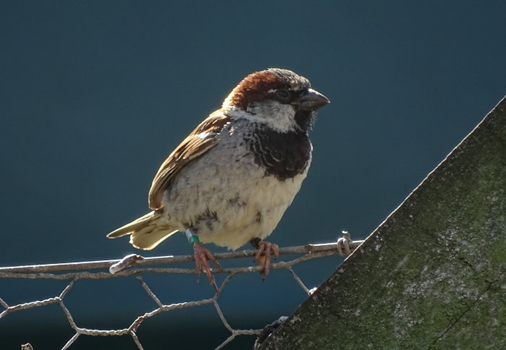
The isolated population of house sparrows (Passer domesticus) on Lundy Island is a unique opportunity to study social behaviours. House sparrows are a monogamous species that also engages in extra-pair copulations. During the breeding season, a black badge becomes visible due to the abrasion of feather tips in the males chest (Figure 1). In autumn, this badge is once again covered by light feather tips when the bird moults. Since this badge only becomes visible during the reproductive months, researchers have raised questions about its function. One hypothesis is that males use the badge to attract mates, while an alternative hypothesis is that it functions in male–male competition. Either case has shown conflicting results, so the function of badges in male sparrows remains an open question.
The aim of this study is to investigate if behaviours (such as aggression, attraction, copulation, and/or others) are associated with badge size in male house sparrows. This will include registering behaviour through direct observations and/or analysis of video recordings, individual identification through the unique colour ring combinations (Figure 2.), and photographing the black badge of males. There is scope to develop project ideas, according to the student’s individual interests.
Tasks may include, but are not limited to:
- Fieldwork assistance for microbiome sample collection;
- Photograph of male’s badges;
- Data recording and note taking;
- Data analysis
Requirements for the role:
Candidates should be curious and enthusiastic about biological research, but also resilient to challenges that may arise during field work on a remote island. The candidate should be able to enter the UK (passport and visa, if required, should be obtained before the start of field work). The working language of the group is English, so a good level of written and spoken English is essential. Dutch language proficiency is not required.
Applications will be reviewed on a rolling basis until the closing date or until the position is filled