Search
Filter by
Type
Tags
Dossiers
Themes
Departments
Active filters
1072 search results
Search results
-
Gas exchange and treatment lab
In a set of larger and smaller cuvettes the gaseous atmospheric composition can be adjusted. This primarily concerns elevated or lower CO2 levels, or reduced oxygen content. Alternative gasses can be supplied, such as stable isotopically labelled 13CO2. Cuvettes are connected via a flow though system, which then also allows whole plant/canopy photosynthesis and respiration measurements.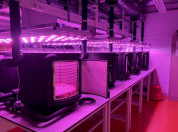
-
Optics lab
Optics lab with equipment to study the optical properties of plant, animal and artificial materials, and study insect eyes. Spectroscopic setups (probe, microspectrophotometer) to measure reflectance spectra, imaging scatterometer to visualise angle-dependence of reflection, angle-dependent reflectance setup to quantify angular dependence of reflectance, various types of microscopes. Goniometric research apparatus to quantify the visual field of insects.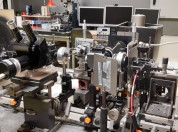
-
Field station De Herdershut
Field station De Herdershut (the shepherd’s hut) of the University of Groningen on the Wadden Island of Schiermonnikoog is the Netherlands' northernmost scientific research station and the home base for research in the eastern Wadden Sea.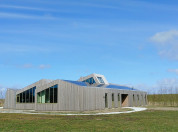
-
Wild bird biobank
The ErasmusMC hosts a biobank that consists of data and samples resulting from two lines of research in wild bird monitoring conducted by the Erasmus Medical Center and the Dutch Centre for Avian Migration: bird flu with a focus on waterbirds (1999-current), and arboviruses with a focus on songbirds (2016-current). The biobank contains samples of birds infected with viruses as well as negative samples (serum, swabs, feathers), and ticks found on birds.
-
Polderlab Vrouwe Venne
At the Polderlab Vrouwe Venne, farmers, citizens and researchers work together to shape the future of Dutch agriculture. Its goal is to restore biodiversity and the peat meadow landscape. And that farmers can earn their living sustainably.
-
Soil ecology runs deep
For a long time, the soil was the domain of chemistry and physics. This only changed forty years ago. Then attention also started to be paid to the biology and ecology of soils. Today, the soil has become a large and indispensable field of research. The Netherlands Institute of Ecology (NIOO-KNAW) has been uncovering the role of soil life for a healthy underground and aboveground ecosystem for several decades. Soil life also contributes to nature restoration, for example through soil transplantation and tackling invasive plants.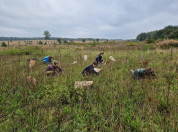
-
Under the bird ring's spell
Ringing of wild birds has become indispensable as a research method to track individual birds. Since 1911, some 16 million birds have been fitted with a metal ring in the Netherlands. What has that brought in terms of knowledge, protection and policy? And what do new tracking techniques add? We dive into the world of meadow birds, goose visits and infectious diseases.
-
Luzia Stalder
Postdoc
-
Stefan Dekker
NIOO Director
-
Ate Hendrik-Jan Jaarsma
Postdoc