PHYVIR expedition: Entering rougher waters


Written by
Phytoplankton, microscopic ocean plants, produce around half of the Earth’s oxygen and play a key role in global carbon cycles. Yet their interactions with viruses, and the impact on ocean health and climate, remain largely unknown. The PHYVIR project aims to change this through a combination of lab research, ocean expeditions and advanced modelling.
In this blog series, we follow the research at sea aboard the RV Anna Weber-van Bosse. From the preparations in the harbour to the measurements in the Atlantic Ocean, we take you behind the scenes of the life and science on board.
Written by Melle Versluis (PhD candidate UvA), Xiaonan Cai (PhD candidate NIOO) and Amelie Wittig (master student UvA)
We started our expedition in tropical waters, where everyone could get used to the daily routines on a research ship in calm and sunny weather. But since we are heading towards Iceland, we were all aware that we cannot count on such calm and flat conditions throughout our entire journey. Yesterday we finally got to experience rougher seas for the first time and the whole experience changed immediately.
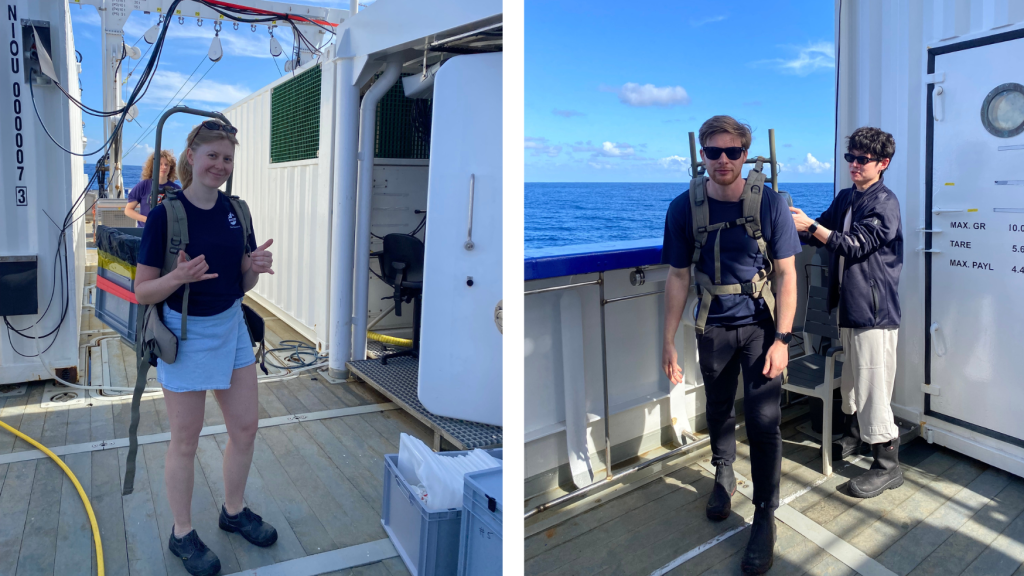
Having seen the predicted wave height in advance, we adjusted the scientific program accordingly. For our team this meant sampling our experiment earlier in the day. The sampling involves carrying 20L cubitainers, in which we incubate water for our experiments, from the incubators in the front of the ship to the ultraclean container (where we sample under clean conditions to avoid contamination) in the back, with two flights of stairs in between. We brought special backpacks to be able to do this safely, and it is a team effort to carry 18 cubitainers back and forth. But in rough seas walking straight becomes close to impossible even without 20kg of extra weight. Thus we rushed to sample earlier in the day and with extra support from the crew we managed to do it faster than ever before. Luckily so, because once the heavy lifting was done and we could focus on processing our samples in the lab containers, keeping the balance became more difficult. Before we knew it, we found ourselves clinging to a lab table or leaning to a wall in order to stay on our legs. Luckily, we had strapped down every single item in our lab container well in advance and sample processing proceeded smoothly.
However, when sitting down for dinner after a long day of work, coordination became even more difficult. On the long dinner tables plates with food were sliding from one person to the next and soon after, even people started sliding sideways while sitting on their chairs. Holding on to the table while also keeping plates and glasses in place did not allow for comfortable eating, and most of us quickly gobbled down some food, to seek a more stable place as soon as possible. Yet such places were not to be found on the ship anymore, instead we had to rush back to the lab to secure the last pieces that could still move: lab chairs, computer screens and fridge and freezer doors all needed some extra straps, before we could call it a day. And even then, rest is hard to find when moving sideways with each wave while trying to fall asleep…