Droevendaalsesteeg 10
6708 PB Wageningen
The Netherlands
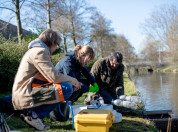
I am on the Citizen Science campaign called 'Vang de Watermonsters' in close collaboration with Natuur & Milieu. This research aims to gain insight in the ecological water quality status of small waters in the Netherlands.
During my studies at Wageningen University I focused on soil and water quality. Next to that I developed a passion to educate others about my research. This combines perfectly in the Citizen Science campaign called 'Vang de Watermonsters' I work on. This research aims to gain insight in the ecological water quality status of smaller waters in the Netherlands. These small waters are merely not monitored for the Water Framework Directive, a European Law that states that all water quality should be good. The deadline for the Water Framework Directive is in 2027, meaning that also these small waters should be of good ecological status. The use of citizen science makes it possible to gain insight in the large amount of waters in the Netherlands. On top of that, the use of Citizen Science gives oppertunity to increase the knowledge and awareness of water quality by the general public. This project is an collaboration with Natuur & Milieu, more information about the project can be found on: www.natuurenmilieu.nl/watermonsters
Meer informatie over het project en de publicaties van de onderzoeksrapporten kunnen gevonden worden op: Citizen Science: Vang de Watermonsters
Nature-based solutions (NbS) aim to restore river ecosystems and improve biodiversity, but their effectiveness in enhancing aquatic ecological quality remains uncertain, especially across different waterbody types. To address this gap, we assessed macroinvertebrate communities in the Border Meuse valley following NbS interventions. Sampling was conducted across the main channel, secondary channels, floodplain lakes, and tributaries. We analysed abiotic conditions, taxonomic composition, abundances, diversity indices, and contributions to regional β-diversity. A total of 218,810 individuals representing 152 taxa were recorded. Lakes and tributaries supported the highest abundances and most unique taxa (∼20 each), while the main channel and secondary channels contributed least to regional diversity. Shannon-Wiener diversity was highest in lakes and lowest in the Meuse. Differences in abiotic conditions further separated lakes and tributaries from other waterbody types. Secondary channels shared characteristics with the Meuse and supported similar macroinvertebrate assemblages, suggesting limited added ecological value. Despite restoration efforts, taxa characteristic of fast-flowing gravel rivers remains largely absent. These results indicate that NbS measures in the Border Meuse, particularly the creation of side channels, had limited effectiveness in restoring aquatic biodiversity. Contributing factors include low habitat heterogeneity, pre-existing modifications in tributaries, and the lack of new floodplain lake creation. We propose five lessons for future NbS planning: conduct thorough system analysis, gather pre- and post-project data, set ecologically realistic goals, implement adaptive management, and promote knowledge sharing. A functional, ecosystem-based approach is essential for improving biodiversity outcomes in large river restoration projects.