PHYVIR expedition: Ready to set sail, but we’ll have to wait a little longer

PHYVIR expedition: Ready to set sail, but we’ll have to wait a little longer
Expeditie virussen van de zeeWritten by

Phytoplankton, microscopic ocean plants, produce around half of the Earth’s oxygen and play a key role in global carbon cycles. Yet their interactions with viruses, and the impact on ocean health and climate, remain largely unknown. The PHYVIR project aims to change this through a combination of lab research, ocean expeditions and advanced modelling.
In this blog series, we follow the research at sea aboard the RV Anna Weber-van Bosse. From the preparations in the harbour to the first measurements in the Atlantic Ocean, we take you behind the scenes of the life and science on board.
And now, they are ready to start...
Arrival
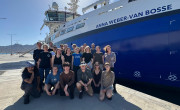
There she was, the RV Anna Weber-van Bosse, the newest research vessel in the Dutch scientific fleet. After a seven-hour flight from Amsterdam, we arrived on Thursday 30 April in tropical Mindelo, the capital of the island of São Vicente in Cape Verde, off the African coast. After going through customs at the international port (well, we’re leaving the country again straight after arrival), we were able to board the ship. There we were introduced to our brand-new home for the next four weeks.
Who’s on board?
We are a diverse group comprising senior researchers, research assistants, post-docs, PhD students and undergraduates from various universities and colleges. In total, our scientific team is a colourful mix of 22 people from 7 countries. We are joined by the ship’s 15-strong crew, whose capable hands ensure that we can sail, eat and carry out our research.
Laboratory at sea
For our research, we need laboratories where we can process water samples. There are three permanent laboratory spaces on board, but that's not enough. Which is why we also have containers that are fitted out according to the researchers’ requirements. For example, there are labs equipped for filtering water samples. The suspended material (such as plankton) is retained on the filters, which we can then analyse. We use these to measure, for example, the total amount of algae in the water. We also use filters to analyse the DNA so that we can see which algae and viruses are present in the water.
Oh no, a delay…
Whilst we were busy setting up the laboratories, we received word that we couldn’t leave just yet. A number of formalities had caused a delay, whilst 1 May is a public holiday in Cape Verde. The advantage for our research team, however, was that we were able to set everything up and secure it properly in the calm waters of the harbour. Because the laboratories at sea… they’ll soon be moving with the waves!
…but we’ve set off!
The time has come; we can set sail! On Saturday 2 May, we receive word that we were cleared to sail. After casting off from the jetty, we sailed towards the harbour mouth, out into the Atlantic Ocean and the real start of our adventure.