PHYVIR expedition: Are the cells feeling alright?


Written by
Phytoplankton, microscopic ocean plants, produce around half of the Earth’s oxygen and play a key role in global carbon cycles. Yet their interactions with viruses, and the impact on ocean health and climate, remain largely unknown. The PHYVIR project aims to change this through a combination of lab research, ocean expeditions and advanced modelling.
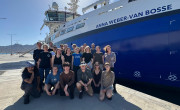
In this blog series, we follow the research at sea aboard the RV Anna Weber-van Bosse. From the preparations in the harbour to the measurements in the Atlantic Ocean, we take you behind the scenes of the life and science on board.
Tiny cells, big clues
The ocean is full of phytoplankton. These tiny organisms form the base of marine food webs and help take up CO₂ from the atmosphere. But phytoplankton are not all the same: different species have different sizes, shapes, and ways of using light and nutrients.
Because of this, phytoplankton communities can change strongly from one place to another. A community in warm, nutrient-poor subtropical waters may look very different from one in colder, nutrient-rich sub-polar waters. During our transect across the North Atlantic Ocean from south to north, one of the questions we are interested in is: how healthy are these phytoplankton cells, and does their photosynthetic capacity and cellular composition change along the way and is that related to external causes such as changes in environmental conditions or viral infection?
Phytoplankton cells carry chemical clues that help us decipher this. One important clue is elemental stoichiometry: the balance of carbon, nitrogen, and phosphorus inside the cells, often written as the ratio of C:N:P. These elements are essential for growth, metabolism, and energy transfer. When the C:N:P balance shifts, it may suggest that cells are adjusting to their environment, experiencing nutrient stress, or changing how they grow.
This is also important for understanding phytoplankton–virus interactions. Being parasites, viruses depend on their hosts to reproduce, so the condition of the host may influence how successful the production of new virus particles will be. A nutrient-stressed cell may not provide the same resources as a healthy cell.
Health across different size groups
Phytoplankton are often grouped into different size classes: microphytoplankton are about 20–200 µm, nanophytoplankton about 3–20 µm, and picophytoplankton 0.3-3 µm. These size classes do not always respond to environmental stressors in the same way. Smaller-sized cells often do well even in nutrient-poor waters because they are efficient at taking up nutrients, while larger cells may become more abundant when nutrients are more available.

During the cruise, we collect seawater and filter it step by step through filters with different pore sizes. This allows us to separate the phytoplankton community into these different size fractions. Sometimes, the filtration itself already gives us a first impression of the water: if the filters clog quickly and the water passes through very slowly, there is probably more particulate material, including phytoplankton biomass. Later, back in the laboratory, we will analyse the filters for elemental composition and the main pigment that phytoplankton contain, i.e., chlorophyll-a. Together, these measurements help us see not only how much phytoplankton material is present, but also how their chemical compositions differ.