Magali Frauendorf

Ir. Magali Frauendorf

PhD Candidate

Visiting Address

Droevendaalsesteeg 10
6708 PB Wageningen

+31 (0) 317 47 34 00

The Netherlands

Social

About

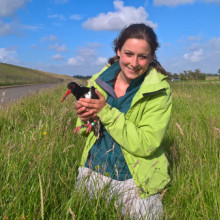
During my PhD, I study the breeding ecology of a declining meadow bird population. I focus on how human impacts and environmental drivers at different stages of the individuals’ annual cycle influence the reproductive success.

Biography

In December 2016 I started my PhD at the Animal Ecology Department of the NIOO-KNAW, where I am supervised by Martijn van de Pol. Within the project CHIRP (Cumulative Human Impact on biRd Populations), I will investigate the main drivers of the reduced reproductive success of oystercatchers as well as the potential for carry-over effects of winter body condition on the performance of oystercatchers in the breeding season.

I studied Wildlife Management (Bachelor of Applied Science) in Leeuwarden and Forest and Nature Conservation (Master of Science) in Wageningen. I got experience to work with several monitoring techniques among several mammal and bird species. I was also used to work with large data sets and analysis with R and ArcGIS during several internships, theses and work.

CV

Employment

  • 2016–Present
    PhD student
  • 2016
    Research assistant at the Institute for Terrestrial and Aquatic Wildlife Research (ITAW)
  • 2013
    Field assistant in the wild boar project at the Institute for Terrestrial and Aquatic Wildlife Research (ITAW)

Education

  • 2014–2016
    Master of Science: Forest and Nature Conservation (specialization Ecology), Wageningen University (NL), cum laude
  • 2008–2012
    Bachelor of Applied Science: Wildlife Management, Van Hall Larenstein, Leeuwarden (NL)

Publications

Key publications

  • Journal of Animal Ecology
    2021

    Conceptualizing and quantifying body condition using structural equation modelling: A user guide.

    Magali Frauendorf, Andrew M. Allen, Simon Verhulst, Eelke Jongejans, Bruno J. Ens, Henk-Jan van der Kolk, Hans de Kroon, ...
    Body condition is an important concept in behaviour, evolution and conservation, commonly used as a proxy of an individual's performance, for example in the assessment of environmental impacts. Although body condition potentially encompasses a wide range of health state dimensions (nutritional, immune or hormonal status), in practice most studies operationalize body condition using a single (univariate) measure, such as fat storage. One reason for excluding additional axes of variation may be that multivariate descriptors of body condition impose statistical and analytical challenges. Structural equation modelling (SEM) is used in many fields to study questions relating multidimensional concepts, and we here explain how SEM is a useful analytical tool to describe the multivariate nature of body condition. In this ‘Research Methods Guide’ paper, we show how SEM can be used to resolve different challenges in analysing the multivariate nature of body condition, such as (a) variable reduction and conceptualization, (b) specifying the relationship of condition to performance metrics, (c) comparing competing causal hypothesis and (d) including many pathways in a single model to avoid stepwise modelling approaches. We illustrated the use of SEM on a real-world case study and provided R-code of worked examples as a learning tool. We compared the predictive power of SEM with conventional statistical approaches that integrate multiple variables into one condition variable: multiple regression and principal component analyses. We show that model performance on our dataset is higher when using SEM and led to more accurate and precise estimates compared to conventional approaches. We encourage researchers to consider SEM as a flexible framework to describe the multivariate nature of body condition and thus understand how it affects biological processes, thereby improving the value of body condition proxies for predicting organismal performance. Finally, we highlight that it can be useful for other multidimensional ecological concepts as well, such as immunocompetence, oxidative stress and environmental conditions.
  • Science of The Total Environment
    2016

    The influence of environmental and physiological factors on the litter size of wild boar (Sus scrofa) in an agriculture dominate

    Magali Frauendorf, Friederike Gethöffer, Ursula Siebert, Oliver Keuling
    The wild boar population has increased enormously in all of Europe over the last decades and caused problems like crop damage, transmission of diseases, and vehicle accidents. Therefore, it is necessary to investigate the underlying causes of this increase in order to be able to manage populations effectively. The purpose of this study was to analyse how environmental (food and climate) and physiological factors (maternal weight and age) as well as hunting and population density influence the litter size of wild boar populations in Northern Germany. The mean litter size in the studied population for the whole period was 6.6 (range 1–12), which is one of the highest in all of Europe. Litter size was positively influenced by maternal body weight, higher mast yield of oak as well as higher temperature in combination with higher precipitation in summer. Only higher temperature or only higher precipitation in summer however had a negative effect on litter size production. Probably, weather and food conditions act via maternal body weight on the litter size variation in wild boar. Hunting as well as population density did not affect the litter size variation in this study which might indicate that wild boar population did not reach carrying capacity yet.

Projects & collaborations

Projects

Collaborations

Élvonal Shorbird Science project

2018–Present

The Élvonal Shorbird Science project (www.elvonalshorebirds.com) is an international project run from Hungary. The project aims to test the key hypotheses of breeding system evolution through the use of behavioural, genomic, immunological, and demographic approaches. Our research focuses on shorebirds (i.e., plovers, sandpipers, and allies) that exhibit an unusual diversity of mating systems and parental care, with data being collected by dozens of connected research teams across the globe.